Safety Minimum Price
Before You Start
What is Safety Minimum Price (SMP)?
The Safety Minimum Price (SMP) is a feature designed to ensure that your minimum nightly rate never drops below a certain threshold. This threshold is based on your historical booking data, specifically the Average Daily Rate (ADR) you received last year for similar stay dates. It helps prevent underpricing, especially for bookings far in advance, by automatically setting a safety net for your minimum prices.
Why Use Safety Minimum Price (SMP)?
Many users may unintentionally underprice their listings due to incorrect settings or market conditions, which can lead to lower-than-expected bookings. For example, if your property was booked at $500 per night last year in July but you accidentally set a low base price this year, you could get bookings at $300 per night. This situation can cause disappointment, especially when preventable. SMP safeguards you by ensuring your minimum price is in line with what you’ve successfully charged in the past.
Calculating Safety Minimum Price
- We take same day of week for last year data.
- By default we consider the weighted average for a 3-week range to normalize impact and negate impact of random events.
- For events & holidays identified by PriceLabs, we take the maximum of a 3-week range.
- If the calculated SMP is lower than your set minimum price, the SMP won't be applied for that date. Instead, your minimum price will take precedence. This ensures that your property will never be priced below the threshold you've set, protecting your rates from underpricing while maintaining flexibility.
Non-holiday and Non-repeating Holiday Dates
- Find Same Time Last Year (STLY) date for Aug 15, 2025 (Friday). This will be Aug 16, 2024, since it's the nearest Friday.
- Find 3 adjacent same weekday dates corresponding to STLY date. This will be Aug 9, 2024 (Friday) and Aug 23, 2024 (Friday)
- Calculate SMP using this formula
- SMP = 1*1 Weighted Average of (STLY, STLY - 1 Week, STLY + 1 Week)
- SMP (Aug 16, 2024) = 1.1* Weighted Average of (Aug 16 2024 ($50), Aug 9, 2024 ($0), Aug 23, 2024 $0)
- SMP (Aug 16, 2024) = 1.1 * $50 (Weighted Average) = $55
Date | STLY | STLY - 1 Week | STLY + 1 Week |
Aug-15-2025 | Aug-16-2024 | Aug-9-2024 | Aug-23-2024 |
SMP = 1*1 Weighted Average of (STLY, STLY - 1 Week, STLY + 1 Week) | $50 | $0 | $0 |
SMP (Aug 16, 2024) = 1.1* Weighted Average of (Aug 16 2024 ($50), Aug 9, 2024 ($0), Aug 23, 2024 $0) | |||
SMP (Aug 16, 2024) = 1.1* * $50 = $55 |
Repeating Holiday and Event Dates
- Anchor Mapping: Instead of comparing calendar dates directly, we map the Exact Date of the holiday in the current year to the Exact Date of the holiday in the previous year.
- Handling Date Spans: For holidays that span multiple days, we calculate the surrounding dates relative to that central Exact Date. If a date is two days prior to the holiday this year, it maps to two days prior to the holiday last year.
- Identify the Exact Holiday Date (Anchor Date)
- For holidays, we first determine the Exact Date of the holiday in both the current year and the previous year.
- This Exact Date acts as the anchor point for all comparisons.
- Example:
- Exact Date (Current Year): July 17, 2026
- Exact Date (Last Year): July 10, 2025
- Map the Exact Date to Same Time Last Year (STLY)
- Once the Exact Date is identified, we map:
- July 17, 2026 → July 10, 2025
- This establishes the central reference point for STLY calculations.
- Map Surrounding Dates Relative to the Anchor
- For holidays spanning multiple days, each date in the range is mapped relative to the Exact Date.
- If a date is:
- 2 days before the Exact Date this year → map it to 2 days before the Exact Date last year
- 1 day after the Exact Date this year → map it to 1 day after the Exact Date last year
- STLY Mapping for the Holiday SpanHoliday Date (Current Year)Relative OffsetSTLY Date (Previous Year)July 15, 2026−2 DaysJuly 8, 2025July 16, 2026−1 DayJuly 9, 2025July 17, 2026Exact DateJuly 10, 2025July 18, 2026+1 DayJuly 11, 2025
- Week Range Consideration for Holidays
- For holidays only, we apply a fixed one-week range when calculating historical comparisons:
- Only STLY − 1 week, STLY, and STLY + 1 week are considered
- This rule applies regardless of the global 3-week or 5-week settings
Key Benefits of Safety Minimum Price (SMP):
- Prevents Underpricing: Ensures your listing doesn’t get booked at a significantly lower rate than in previous years.
- Customizable Control: Allows you to decide when and how SMP applies to your listings.
- Protects Far-Out Bookings: Especially useful for long-term dates where market fluctuations may cause prices to dip unexpectedly.
- Effortless Setup: Easy to implement for both small hosts and large property managers, with scalable options across accounts or individual listings.
Applying Safety Minimum Price
Safety Minimum Price Options
- PriceLabs Recommended: This setting looks at last year’s ADR for the same dates and applies it to your current rates, ensuring you don't go below the successful price points of the past.
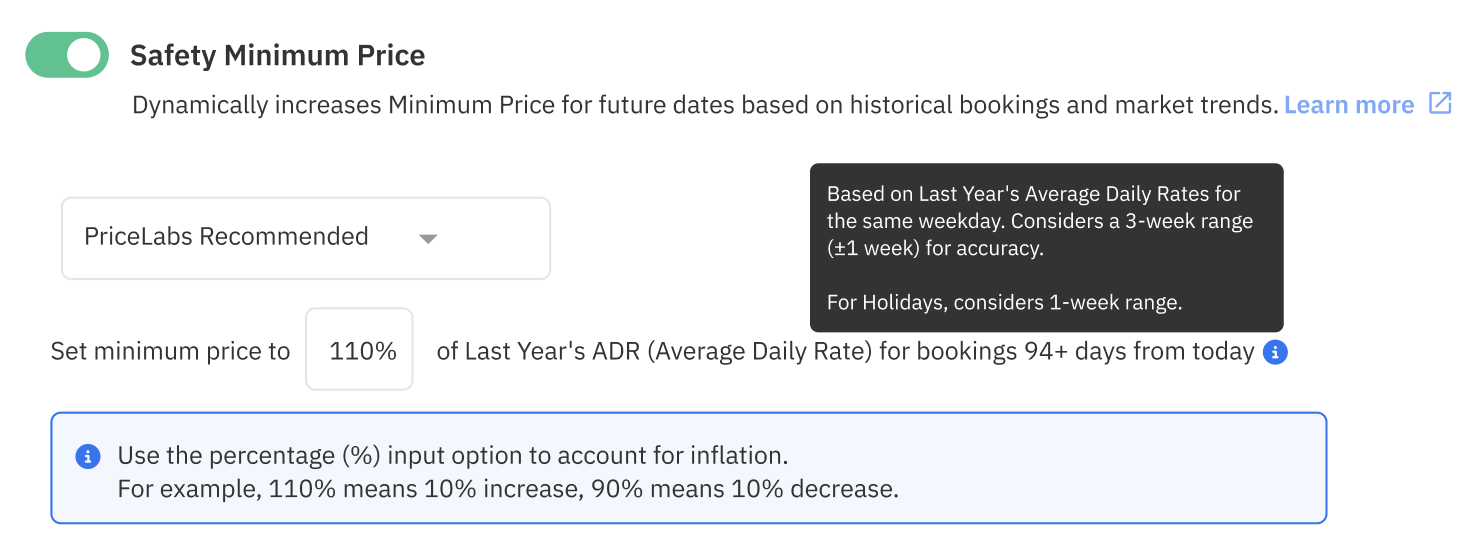
- Note the % input box in the above helps with determining the inflation impact. For example, if you want that for the coming year, you want your SMP to be 10% more than last time of what you charged your guests.
- You might not want to keep this number very high. 110% is safe choice, you can also choose a number that is smaller like 100% or 105% (signifying no or 5% raise respectively)
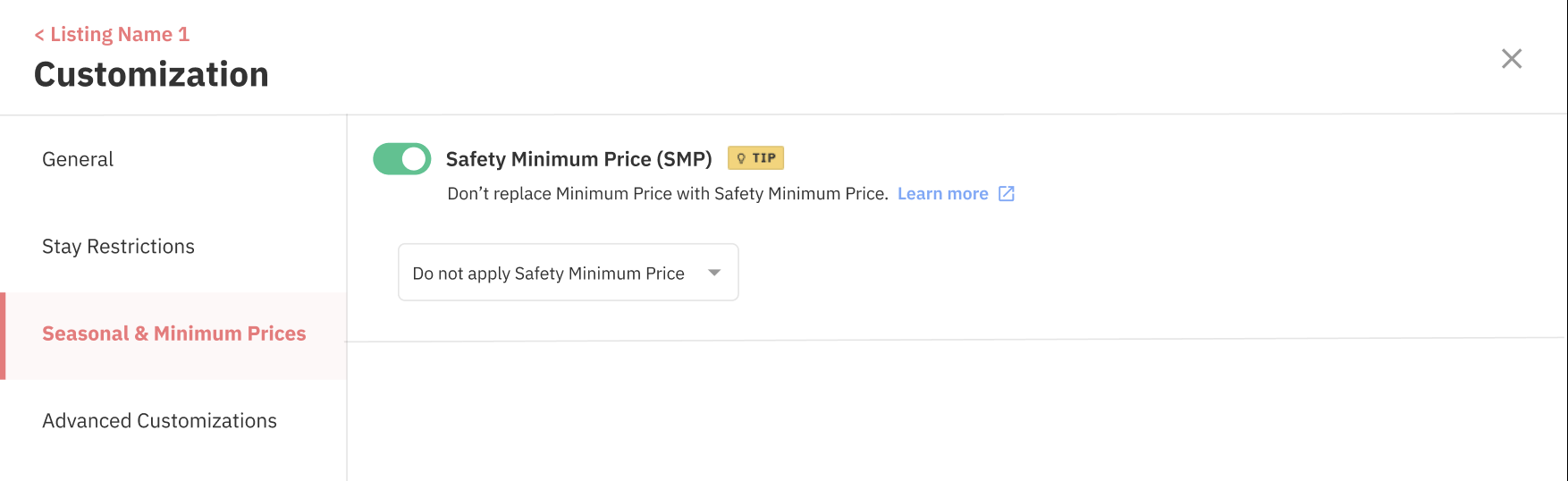
- Do Not Apply Safety Minimum Price: SMP will not be used for your listings. The minimum price that you have set for your listing will be in effect.
- Custom Option: In this mode, you can customize SMP by adjusting it based on specific date ranges, holidays, or other preferences.
Updating Listing Level Safety Minimum Price
- From the Pricing Dashboard, click on the "Review Prices" button
- Once on the Pricing Calendar, click the "Edit" button on the Customizations panel
- Go to the All Customizations tab and enable the toggle for Safety Minimum Price
- Configure your Safety Minimum Price and save your changes
Disabling Listing Level Safety Minimum Price
- From the Pricing Dashboard, click on the "Review Prices" button
- Once on the Pricing Calendar, click the "Edit" button on the Customizations panel
- Go to the All Customizations tab and enable the toggle for Safety Minimum Price
- Select No Safety Minimum Price and save your changes
Updating Safety Minimum Price at Group or Account Level
You can apply SMP across multiple listings or groups if you manage several properties. By setting SMP at the group or account level, you ensure that all properties under your management benefit from historical pricing intelligence. This is particularly useful for property managers overseeing large portfolios where manual adjustments for each property would be time-consuming.
- Click on Dynamic Pricing at the top row and choose "Customizations" from the dropdown
- Navigate to "Accounts" or "Groups" then click the "Edit" button on the Account or Group panel
- Go to the All Customizations tab and enable the toggle for Safety Minimum Price
- Configure your Safety Minimum Price and save your changes
- If your account (i.e. your PMS or Channel Manager) does not support giving Nightly Revenue (without taxes, fees etc.) to PriceLabs, you won't be able to see the option of SMP.
- If you are applying SMP at Group level, and if you manage listings with multiple PMS/Channel Manager, then SMP will only apply to listings in the group whose PMS/Channel Manager supports Nightly Revenue (without taxes, fees etc.) to PriceLabs.
Using Safety Minimum Price for Pricing Profiles
- If you use Pricing Profiles to segment your listings (e.g., high season vs. low season), SMP integrates seamlessly.
- If you use Pricing Profile with a defined SMP for a listing that does not support SMP, then SMP will not be applied for that listing.